
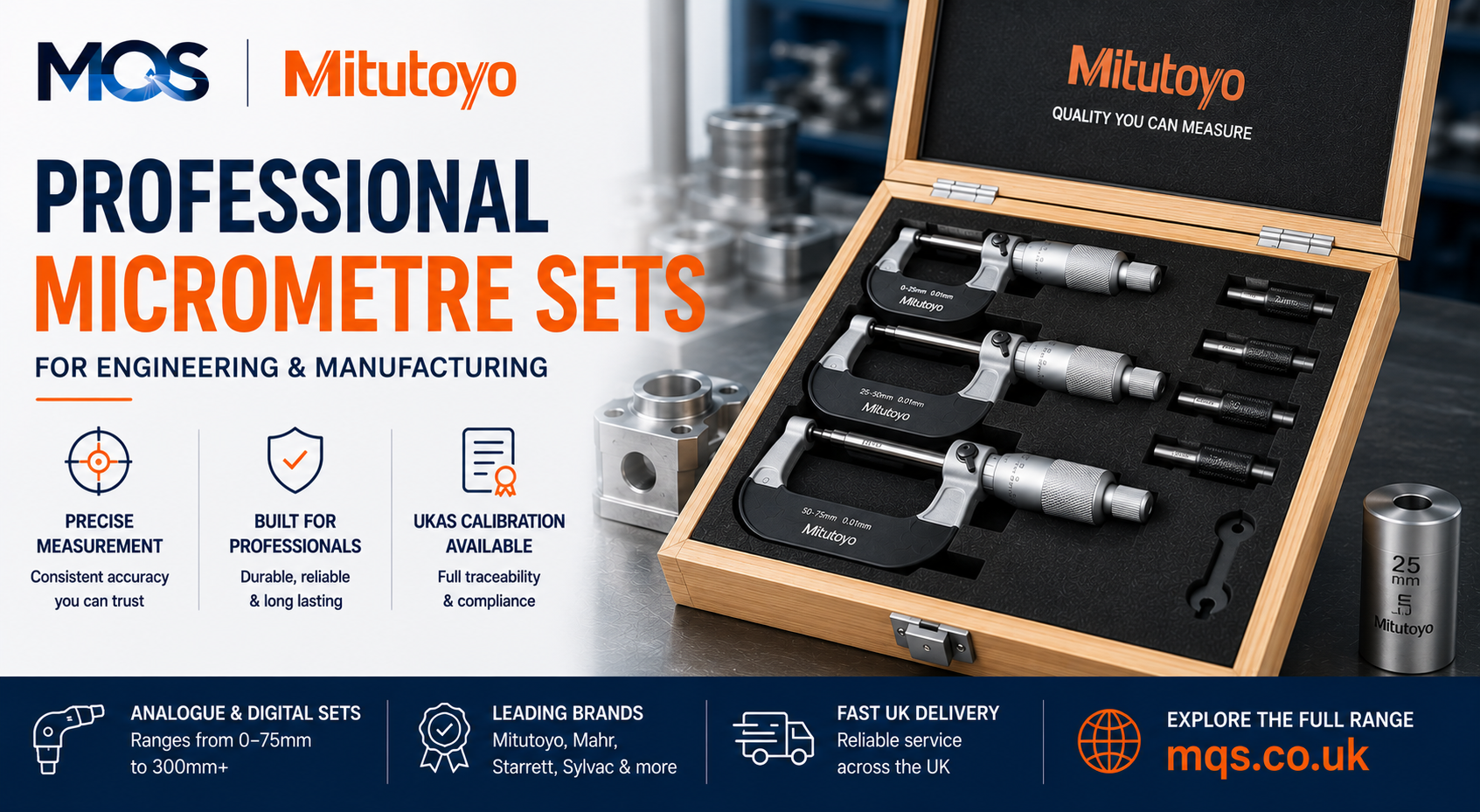
Most workshops buy micrometers one at a time. A 0–25mm here, a 25–50mm when the job demands it. Before long, you have a drawer full of instruments with mismatched calibration dates, no common storage and a gauge register that takes twenty minutes to reconcile.
A professional micrometer set solves that quietly. Same manufacturer, matched calibration intervals, stored together, ready for audit.
Why Sets Make More Sense Than Singles
BS EN ISO 9001:2015 Clause 7.1.5 requires documented traceability for every monitoring and measuring resource. Keeping track of ten separate instruments from several manufacturers can quickly become an administrative task in its own right. A precision micrometer set from a single manufacturer, calibrated together, certificated together, cuts that workload significantly.
It’s also a gauge R&R consideration. When multiple operators are measuring the same component across a range, consistency of instrument type matters. Mixed tooling introduces variables that have nothing to do with the part.
Mechanical or Digital: What Your Application Needs
The choice between analogue and digital micrometer sets comes down to environment and workflow, not preference.
Mechanical micrometer sets, 0.01 mm or 0.001” graduation, are the default in most UK workshop and inspection environments. Mitutoyo 103-907, Mitutoyo 103-908, and Mitutoyo 103-909 are commonly selected for precision outside measurement applications and are supplied with setting standards and a fitted case, making them suitable for routine calibration and inspection workflows.
For inspection cells where data output matters, SPC collection, Cp/Cpk reporting to a Tier 1 customer, digital micrometer sets are worth the step up. The Mitutoyo 340-521-30 and 340-522-30 Digimatic sets offer IP65 protection and direct SPC output, which removes the transcription errors that paper-based recording introduces.
Choosing a Set by Range
This is where most procurement decisions go wrong. Buying a 0–75mm set for a workshop that regularly measures up to 150mm means the set gets supplemented with individual instruments, and you are back to the mixed-gauge problem.
|
Measuring Range |
Set Type |
Typical Application |
|
075 mm / 0-3” |
3-piece analogue or digital |
General engineering, first-off inspection |
|
0-100 mm / 0-4” |
4-piece analogue |
Production |
|
0-150 mm / 0-6” |
6-piece analogue |
Fabrication, larger component inspection |
|
0-300 mm+ |
Interchangeable anvil |
Large-diameter work, tool room |
Interchangeable anvil micrometer sets cover large ranges from a single frame, a practical choice for tool rooms measuring across wide dimensional spreads without storing six separate instruments.
The Brand Question
Mitutoyo micrometer sets account for the majority of what serious UK inspection departments specify. The 103-series analogue sets and 340-series digital sets are NPL/UKAS traceable out of the box and backed by a calibration recall infrastructure that most UK UKAS-accredited laboratories stock, setting standards as a matter of course.
That said, Starrett, Mahr and Sylvac all have a place. Starrett’s interchangeable anvil sets suit a large range of tool room work. Mahr’s outside micrometer sets carry a build quality that holds up in high-cycle production environments. The right brand depends on what the instrument is doing, not what’s on offer.
What Comes Next After the Purchase
A micrometer set without a calibration plan is a short-term solution. Under IATF 16949 and BS EN ISO/IEC 17025:2017, your calibration recall schedule needs to be defined, documented and actioned and the certificates need to be accessible when your auditor asks for them.
MQS supplies micrometer sets from Mitutoyo, Mahr, Starrett, Sylvac and more, with UKAS-accredited calibration available at the point of purchase or through the customer calibration portal for ongoing recall management. On-site calibration is available for production environments where removing instruments from the line isn't practical.
Browse the full range at MQS or call 02476 644661 to speak with the team.