
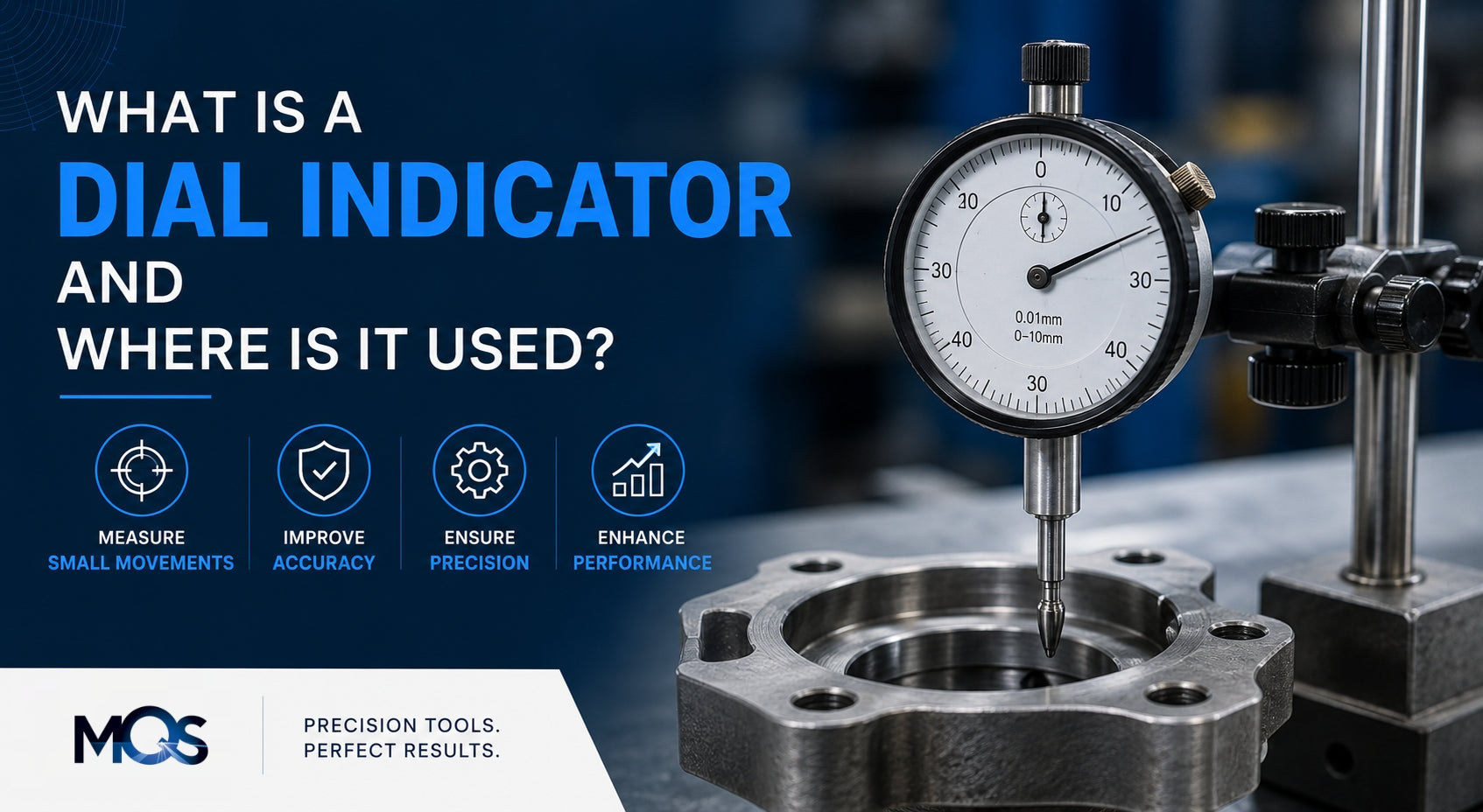
The first thing you'll notice when you walk into a workshop is that everything needs to be right. A part's fit or function can change with even a small change in size or position. That's when a dial indicator comes in handy.
You might have heard terms like dial indicator UK, 'dial gauge measurement', or 'dial gauge'. They can sound a bit technical, but the tool itself is quite simple. It’s used to check very small movements that you can’t easily see. That’s why engineering dial indicators are used so often in day-to-day work.
Let’s go through it in a simple way
What is a Dial Indicator?
A dial indicator is a tool that lets you see small changes in position or movement. It isn't for measuring big things like a ruler. Instead, it helps you see very small changes.
It has a round dial and a needle. When the tip touches a surface and moves, the needle moves too. That movement shows the change. In many workshops across the dial indicator UK range, this tool is used for quick checks. A precision dial gauge is helpful when you need to look at very small differences.
So when people talk about dial gauge measurement, they simply mean checking small changes using this tool.
How Does It Work?
The idea is simple: you place the tip of the dial indicator against a surface. If the surface moves, even a little, the needle shows that movement.
That’s why engineering dial indicators are so useful. They show how much something has moved from a set point. In many cases, dial gauge measurement is used to compare parts. Instead of measuring size directly, you check if something has moved or changed.
Most tools in the dial indicator UK range work in the same basic way, whether they are used in small workshops or larger setups.
Where is a Dial Indicator Used?
Dial indicators are used anywhere small measurements matter. You’ll often see engineering dial indicator in workshops, factories, and repair work.
Here are some common uses:
Checking Alignment
A precision dial gauge helps check if parts are lined up properly. Even a small shift can cause issues later.
Machine Setup
Before starting work, machines need to be set correctly. A dial indicator UK tool helps make sure everything is in place.
Measuring Runout
Runout is how much a part moves while spinning. With dial gauge measurement, you can check if it runs smoothly.
Surface Checking
A precision dial gauge can help check if a surface is flat or slightly uneven.
Inspection Work
In many cases, engineering dial indicators are used to check if parts are within limits.
Why Dial Indicator Matters
It may look like a small tool, but it’s very useful in daily work. A UK dial indicator tool helps you:
-
Find small mistakes early
-
Keep the parts the same
-
Make sure everything fits right.
Stay away from problems while putting things together. If you measure with a dial gauge correctly, you can catch small problems before they get worse.
A precision dial gauge also helps you save time. Instead of guessing, you get a clear reading straight away.
Types of Dial Indicators
There are a few types of engineering dial indicators, but they all do similar work.
Some of the most common ones are:
-
Standard dial indicators for everyday use
-
Indicators with levers for tighter spaces
-
Digital versions that are easier to read
In the dial indicator UK market, you’ll find different options depending on the job.
Get the Right Tools for the Job
If you’re looking for reliable dial indicator UK options, it’s worth checking out MQS. They offer a good range of precision dial gauge tools for everyday dial gauge measurement.
You can explore their selection of engineering dial indicators and find something that fits your work without overcomplicating things.